
-
Read the WELCOME ALL BMWFANATICS post.
You are using an out of date browser. It may not display this or other websites correctly.
You should upgrade or use an alternative browser.
You should upgrade or use an alternative browser.
Fuel consumption: Not filling your tank
- Thread starter Just-ify
- Start date

LAWLESS BMW
New member
I used to do this just for normal driving around, keep the car weight down, but it started getting annoying going to get petrol all the time, so now I just full up.
But I think it does make sense, less weight = less right foot = less petrol used.
Just my 2c!
But I think it does make sense, less weight = less right foot = less petrol used.
Just my 2c!

Just-ify said:Hi guys,
I was wonder - if you're doing a long journey, would it make sense to only fill up the tank half way per fills - that way reducing the overall car weight?
Anyone ever done the math?
 imp:
imp:That would mean you would have to stop more regularly to fill up, thus making you have to pull off again, so might as well just fill up and cruise on I would think?? :dunno:

Just-ify said:Hi guys,
I was wonder - if you're doing a long journey, would it make sense to only fill up the tank half way per fills - that way reducing the overall car weight?
Anyone ever done the math?
I haven't done the exact math, but when doing 120km/h on the highway, drag is a big factor compared to weight. If you are driving constant speed, weight has almost NO effect on how much power is needed to maintain momentum because the engine is only trying to overcome this drag from air resistance and drive train friction. So first order theory is that it won't make any difference.
Now taking it further, if drag is the only factor, then frontal area and drag coeficient are the factors that contribute. And if you you load more in your car, such as a more fuel, then your car will be slightly lower, decreasing your frontal area. So in actual fact, your consumption might just go up. Your top speed will definately go up if you put enough weight in it to actually lower the car.

also alot of petrol evaporates when you fill up the less you open your tank the better...

328ii
New member
Load effects tire drag as show...
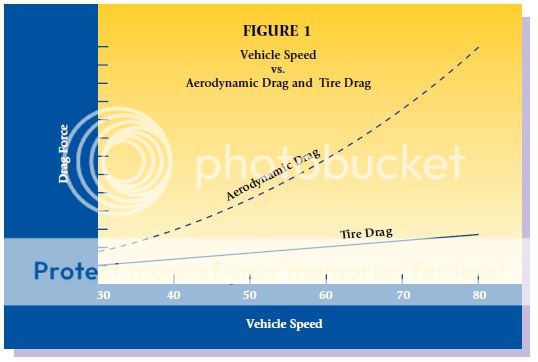
Note: Speed axis in mph.
I doubt much savings for small loads.
Maybe on a truck there can be a substantial difference between empty and loaded (for the same speed).
Also : You may save a bit of fuel by slowing down to add fuel if it is not too far out of your way.
Note: Speed axis in mph.
I doubt much savings for small loads.
Maybe on a truck there can be a substantial difference between empty and loaded (for the same speed).
Also : You may save a bit of fuel by slowing down to add fuel if it is not too far out of your way.
328ii
New member
Devtri said:The difference is miniscule and besides just addes frustration to filling up more often and spending time at the gas stations.
It may be good to relax & stretch a leg on a long journey...ur right, it does take time.
Which can be a good reason to put foot again..!
8?>

Ephraimramodike
New member
killua said:Just-ify said:Hi guys,
I was wonder - if you're doing a long journey, would it make sense to only fill up the tank half way per fills - that way reducing the overall car weight?
Anyone ever done the math?
I haven't done the exact math, but when doing 120km/h on the highway, drag is a big factor compared to weight. If you are driving constant speed, weight has almost NO effect on how much power is needed to maintain momentum because the engine is only trying to overcome this drag from air resistance and drive train friction. So first order theory is that it won't make any difference.
Now taking it further, if drag is the only factor, then frontal area and drag coeficient are the factors that contribute. And if you you load more in your car, such as a more fuel, then your car will be slightly lower, decreasing your frontal area. So in actual fact, your consumption might just go up. Your top speed will definately go up if you put enough weight in it to actually lower the car.
Are you a scientist or mathematician by any chance? :thinking:
Coz your tone and written language is deep man... #Just teasing :biglol:
You're making sense.
:thumbs:
Ephraimramodike said:killua said:Just-ify said:Hi guys,
I was wonder - if you're doing a long journey, would it make sense to only fill up the tank half way per fills - that way reducing the overall car weight?
Anyone ever done the math?
I haven't done the exact math, but when doing 120km/h on the highway, drag is a big factor compared to weight. If you are driving constant speed, weight has almost NO effect on how much power is needed to maintain momentum because the engine is only trying to overcome this drag from air resistance and drive train friction. So first order theory is that it won't make any difference.
Now taking it further, if drag is the only factor, then frontal area and drag coeficient are the factors that contribute. And if you you load more in your car, such as a more fuel, then your car will be slightly lower, decreasing your frontal area. So in actual fact, your consumption might just go up. Your top speed will definately go up if you put enough weight in it to actually lower the car.
Are you a scientist or mathematician by any chance? :thinking:
Coz your tone and written language is deep man... #Just teasing :biglol:
You're making sense.
:thumbs:
Engineer with math and physics as a side hobby
328ii said:Load effects tire drag as show...
Note: Speed axis in mph.
I doubt much savings for small loads.
Maybe on a truck there can be a substantial difference between empty and loaded (for the same speed).
Also : You may save a bit of fuel by slowing down to add fuel if it is not too far out of your way.
The graph does not match your assumption that "Load effects tire drag as show". Graph has no reference to weight/load, only to speed.
The drag from the wheels, drivetrain etc goes up with speed. But all this is still very small compared to aerodynamic drag.
Ephraimramodike
New member
:thumbs:
328ii
New member
Ass-u-me we consider 1/2 tank and full tank to be 30 and 60 liters.
The question then is how will ~<30 kg affect frontal area and tire drag
If the car weight distribution is 50/50 that is ~7.5 kg per wheel
A basic equation for the force it takes to push something through air :
Aerodynamic drag = 1/2 D x A x V^2
Where...
D is the density of the air
A is the frontal area of the vehicle
V is its velocity relative to the air
For real body shapes & air at standard conditions...
Drag = K x Cd x A x V^2
Where Cd is the drag coefficient
Above shows that velocity is more of a factor than area as it is squared.

The question then is how will ~<30 kg affect frontal area and tire drag
If the car weight distribution is 50/50 that is ~7.5 kg per wheel
A basic equation for the force it takes to push something through air :
Aerodynamic drag = 1/2 D x A x V^2
Where...
D is the density of the air
A is the frontal area of the vehicle
V is its velocity relative to the air
For real body shapes & air at standard conditions...
Drag = K x Cd x A x V^2
Where Cd is the drag coefficient
Above shows that velocity is more of a factor than area as it is squared.

328ii said:Ass-u-me we consider 1/2 tank and full tank to be 30 and 60 liters.
The question then is how will ~<30 kg affect frontal area and tire drag
To be scientific - almost nothing..?
8?>
None at all, yes... Thats why I said "might just go up". Its just a argument against all other reasonings saying that weight has a negative effect on consumption. Same goes for drag from the tyres...
While I am at it, I can just add, the weight of the car has no effect on consumption on a straigt road, but if driving long trip you are bound to encounter hills. There weight does make a difference because the weight of the car isn't perpendicular to the plane of movement, so weight will work in your favour downhill and against uphill.
328ii said:If the car weight distribution is 50/50 that is ~7.5 kg per wheel
A basic equation for the force it takes to push something through air :
Aerodynamic drag = 1/2 D x A x V^2
Where...
D is the density of the air
A is the frontal area of the vehicle
V is its velocity relative to the air
For real body shapes & air at standard conditions...
Drag = K x Cd x A x V^2
Where Cd is the drag coefficient
Above shows that velocity is more of a factor than area as it is squared.
This has no relevance to this thread.... The extra weight on the wheel has no relevance to your equation, neither does your equation directly contribute to solving the problem of weight vs consumtion. The equation just shows that linearly decreasing your cruising speed exponentially decreases drag/fuel consumption.
Are you a troll? :fencelook:
:roflol:

Major
Active member
Surely having a heavier tank for a longer amount of time is better. You're only trying to maintain 120km/h. At this point, you're hardly using the pedal like you would in the city, and the heavier load keeps momentum going. Allows you coast for longer downhill and gives you greater coasting distance coasting uphill, no difference on a straight road.
Then again, we're talking about 30kg in a car that weighs 1100-1200kg? Just fill up damnit.
Then again, we're talking about 30kg in a car that weighs 1100-1200kg? Just fill up damnit.
328ii
New member
killua said:328ii said:Ass-u-me we consider 1/2 tank and full tank to be 30 and 60 liters.
The question then is how will ~<30 kg affect frontal area and tire drag
To be scientific - almost nothing..?
8?>
None at all, yes... Thats why I said "might just go up". Its just a argument against all other reasonings saying that weight has a negative effect on consumption. Same goes for drag from the tyres...
While I am at it, I can just add, the weight of the car has no effect on consumption on a straigt road, but if driving long trip you are bound to encounter hills. There weight does make a difference because the weight of the car isn't perpendicular to the plane of movement, so weight will work in your favour downhill and against uphill.
328ii said:If the car weight distribution is 50/50 that is ~7.5 kg per wheel
A basic equation for the force it takes to push something through air :
Aerodynamic drag = 1/2 D x A x V^2
Where...
D is the density of the air
A is the frontal area of the vehicle
V is its velocity relative to the air
For real body shapes & air at standard conditions...
Drag = K x Cd x A x V^2
Where Cd is the drag coefficient
Above shows that velocity is more of a factor than area as it is squared.
This has no relevance to this thread.... The extra weight on the wheel has no relevance to your equation, neither does your equation directly contribute to solving the problem of weight vs consumtion. The equation just shows that linearly decreasing your cruising speed exponentially decreases drag/fuel consumption.
Are you a troll? :fencelook:
:roflol:
The force of rolling resistance (not adjusted for velocity) can be calculated by :
F= Cr*W
where
F is the rolling resistance force (drag)
Cr is the rolling resistance coefficient or coefficient of rolling friction (0.010 to 0.015)
W is proportional to Weight (load)

One part theory that is so missing here is that we do not live in an flat world. SO of you live in flatter places but some of us dont. As soon as it is not flat anymore weight does have an effect. think of driving up an hill.
That said the effect of not filling up isso small that it will probably be negated by needing to stop more and pull away more.
That said the effect of not filling up isso small that it will probably be negated by needing to stop more and pull away more.
328ii said:The force of rolling resistance (not adjusted for velocity) can be calculated by :
F= Cr*W
where
F is the rolling resistance force (drag)
Cr is the rolling resistance coefficient or coefficient of rolling friction
W is proportional to Weight (load)
Now you are getting nearer...
But!!! Even if there is a linear relationship between weight and resistance, the force is still substatially less than air drag, which is why I didn't bring it up. It could be, like all things in life, that this effect of resistance gets cancled out by the drop in frontal area due to the drop in ride height.
:rollsmile: :rollsmile: :rollsmile:
Similar threads
- Replies
- 8
- Views
- 2K


- Replies
- 70
- Views
- 15K


- Replies
- 22
- Views
- 21K

- Replies
- 0
- Views
- 2K
