

ETHANOL 95/e5: THE NEW POWER ADDER.
More & more fanatics are using ethanol to boost the octane in their cars. But it has been preceded with lots of frowning, vexed questions and outright uncertainty but also with a good measure of interest. There has been a number of international articles carrying mixed reactions & claims that the Ethanol (E15) in some countries can be damaging to vehicles fuel systems but that Ethanol (E85) are great for performance cars and are being used without reported issues. Whatever, the differing views the renewable energy lobbyists and agriculturists will be pleased about this unexpected development in a product that has been around for a long time. South Africa is planning the first major bio-ethanol production facility in 2013 to use sorghum to produce ethanol instead of wheat or cane. These developments bode well for an industry that has been dependent on the US for the major supply of ethanol. How this will translate in South Africa to use and promote ethanol as an alternative energy fuel source in production cars remains uncertain.
Interestingly, I heard and encountered the same uncertainty when performance enthusiasts started using water/methanol. Concerns ranging from water/meth safety; installation configurations; how does it work and how much power does it generate; what kind of mix is safe & gives the best bang for buck. But despite the concerns the use of water/meth for everyday driving is now more common place then we would think, because of our insatiable desire for better fueling options.
However, this thread is to share a review of the practical requirements, tests and use of ethanol 95/e5 in the x35 motor. As well as demystifying the use of ethanol & to finaly open this debate publicly on this forum.
ETHANOL BASICS
Ethanol (CH3CH2OH) is a clear, colorless liquid. Also known as ethyl alcohol, grain alcohol, and EtOH, the molecules in this fuel contain a hydroxyl group (-OH) bonded to a carbon atom.
Ethanol is made of the same chemical compound regardless of whether it is produced from starch- and sugar-based feedstocks, such as corn grain, sugar cane, or from cellulosic feedstocks. (Source)
ETHANOL AS A MOTOR FUEL?
Wikipedia: "The largest single use of ethanol is as a motor fuel and fuel additive. More than any other major country, Brazil relies on ethanol as a motor fuel. Gasoline sold in Brazil contains at least 25% anhydrous ethanol. Hydrous ethanol (about 95% ethanol and 5% water) can be used as fuel in more than 90% of new cars sold in the country. Brazilian ethanol is produced from sugar cane and noted for high carbon sequestration. The US uses Gasohol (max 10% ethanol) and E85 (85% ethanol) ethanol/gasoline mixtures. Ethanol may also be utilized as a rocket fuel, and is currently in lightweight rocket-powered racing aircraft."
DIFFERENCES BETWEEN e85 (US, EU & Brazil) AND 95/e5 in SOUTH AFRICA
I need to clarify this, because this has been falsely explained on US & international car forums.
It is not the same.
e85 in the US is already a pre-mixed ethanol and petrol blend which you can buy at certain fueling stations in the US & EU.
The 95/e5 composition in South Africa from Crest, Protea chemicals or SASOL and the major chemical plants is:
Ethanol 95% & Ethyl acetate 5%
Our ethanol has not been pre-mixed with petrol that you buy at a petrol station. I hope this point is clear. Of course you can buy pre-mixed ethanol/petrol from automotive workshops but it will be the (mix) of that particular workshop and they may be reluctant to reveal what the mix brew consists of.
TESTING ETHANOL IN UNLEADED PETROL & MIXED SAMPLES
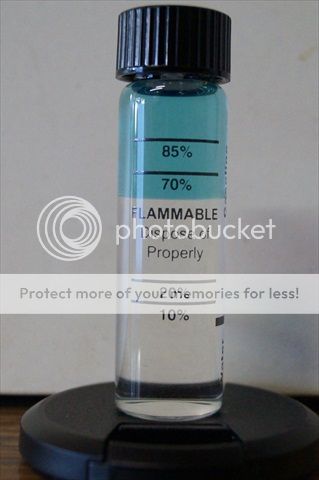
Biofuel plants employ two methods for measuring ethanol concentration: Infrared ethanol sensors or a hydrometer to calculate ethanol content. Unfortunately, I dont have access to such fancy equipment and rely on a laboratory glass container best known as a test tube or graduated cylinder which can test from 0 - 85% alcohol in 1% increments. This kit may not be 100% perfect but serves as a simple guide to determine the percentage of ethanol or water content of a fuel sample.
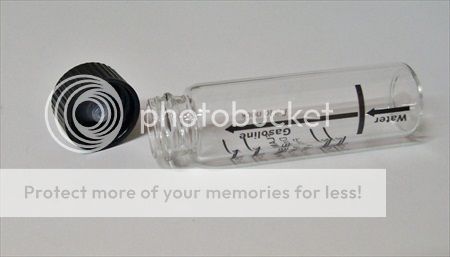
TESTING PROCEDURES -
TEST ONE
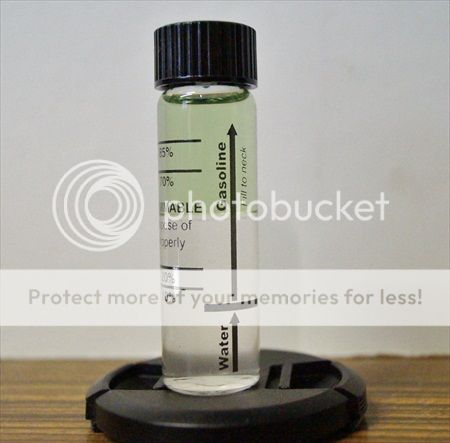
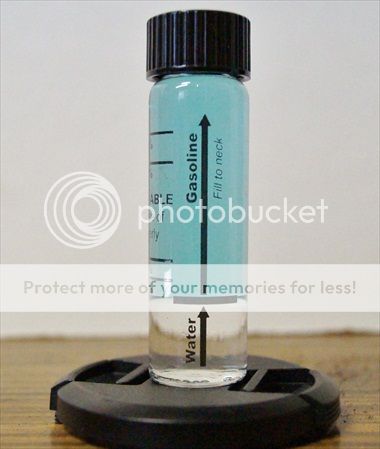
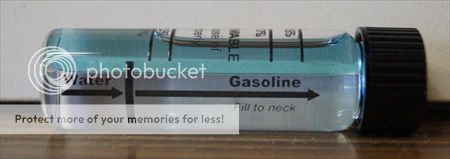
1. Fill tube with distilled water up to the water mark. This is about 25-percent of the total volume in the tube:
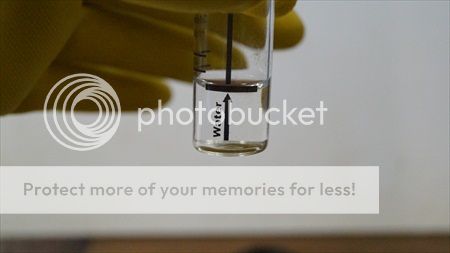
2. Add the fuel sample to the neck of the bottle which is about 75-percent volume of the test tube. Replace cap and shake vigorously. Stand the tube upright with cap tight for 10 minutes and allow the solution to separate into two phases. In this test I used straight 95 pump fuel from my local Engen garage to see if any ethanol was present.
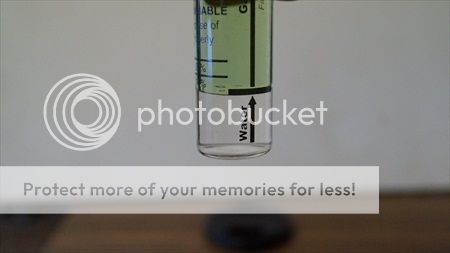
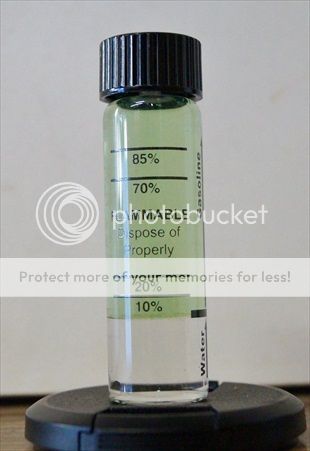
3. Locate the water/fuel seperation line and read the scale. The seperation line will indicate the percentage of ethanol if present.
In this test there was zero ethanol present in the 95 Unleaded pump fuel sample.
4. After the test dispose of the tube mix properly because it can be quite messy.
The above tube test may probably not be 100 - percent accurate for students in chemical engineering. I understand that when chemical reagents of a certain volume mix together the resulting solution does not always have a volume equal to the sum of the two reagents' volumes. So if you are an experienced lab technician or someone with a critical mathematical mind you can read up on a more detailed and accurate mathematical testing formula in one of the references at the bottom of this post.
TESTING 95/e5 ETHANOL
Now that we are familiar with the simple testing procedure lets do some ethanol testing. I grabbed some 95/e5 ethanol from Crest Chemicals.
Crest Chemicals or Protea Chemicals in Cape Town: Ethanol 95/e5
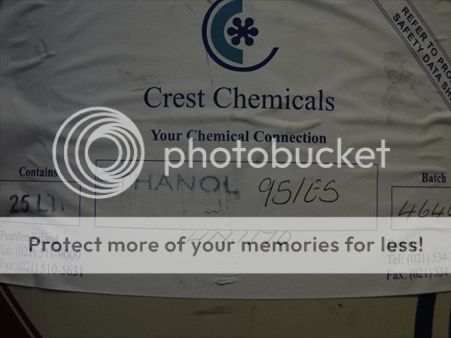
Ethanol Datasheet of the Crest Chemicals sample drum:
Composition: Ethanol 95% & Ethyl acetate 5%
Trade / Commercial Name: ETHANOL 95/E5
Chemical Name: Ethyl alcohol
Formula: C2H6O
Chemical Family: Alcohol
Synonyms: Ethanol; Anhydrol; alcohol; methylcarbinol; Denatured alcohol; ethyl hydrate; ethyl hydroxide;
TEST TWO
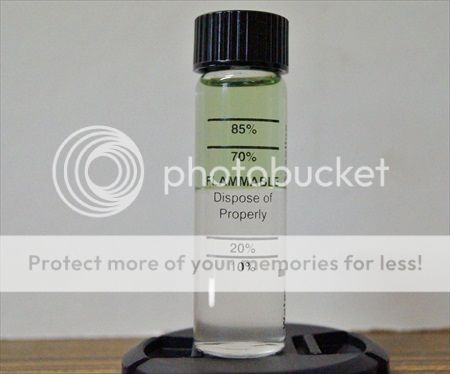
10 Liters 95 Unleaded Pump Fuel mixed with 10 Liters 95/e5 Ethanol -
Outcome, approximately 50% Ethanol
TEST THREE
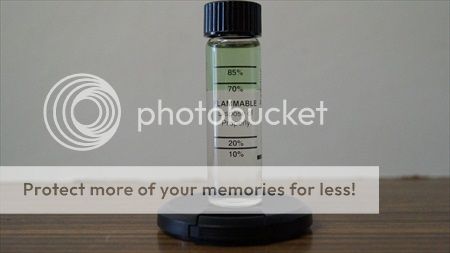
10 Liters 95 Unleaded Pump Fuel mixed with 12 Liters 95/e5 Ethanol.
Outcome, approximately 68% ethanol.
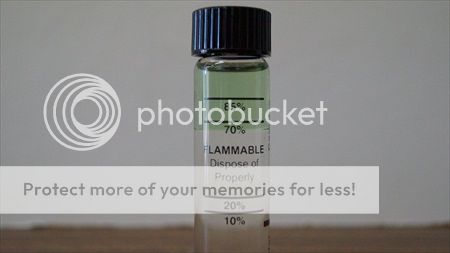
TEST FOUR
I got hold of some BP 98 Unleaded Racefuel for interest sake and mixed a sample with distilled water. Outcome, zero ethanol present.
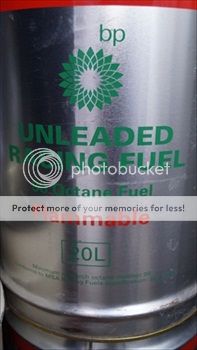
TEST FIVE
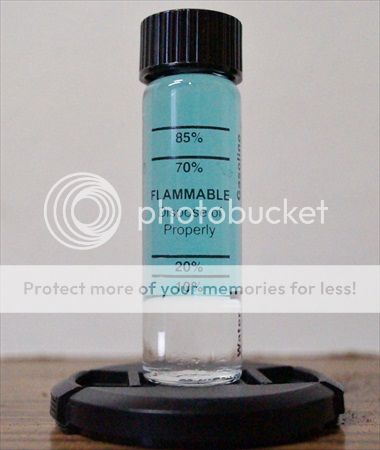
10 Liters, BP 98 Unleaded mixed with 12 Liters, 95/e5 Ethanol.
Outcome, approximately 65% Ethanol mix.
WHAT IS THE RON OCTANE RATING IN 95/e5?
Eish, how I looked for clarification on this question.
The short answer is: The actual octane value that you will get by adding ethanol to a fuel will vary substantially depending on what the base fuel was made of.
Most literature indicate that pure ethanol (non-denatured) will typically have a RON value of between 109 - 120 Octane. Since 95/e5 Ethanol is "denatured" a reasonable rating target would be 100.5 RON value. Popular internet answers also point out an important fact that Ethanol may actually have an even higher added "combustion enhancing" effect due to the latent heat of vaporization. So the jury is still out there until someone actually test the RON value of 95/e5 in a laboratory.
VEHICLE REQUIREMENTS BEFORE USING ETHANOL 95/E5
Unless you have purchased a full flexible sedan from Brazil to run on 100% ethanol; you cannot just pour ethanol in your car and expect it to perform. It is not going to happen and the worse case will be a damaged motor.
Modern vehicles require some modification to enable it to accept ethanol in the tank. The most common modification is a Flex Fuel Sensor. Its a device that measures and monitors the ethanol content in the car’s fuel system and is installed between the fuel pressure regulator and the fuel tank. That information is then passed onto the ECU (in the flex fuel sensor) which applies fuel, ignition and boost corrections to make the best power for the ethanol content available. There are excellent flex sensors available for various model vehicles that allows any mixture of ethanol and petrol mix (from 0-100% ethanol content).

The x35 motor also benefits from a flex fuel sensor (Above image) either sold seperately or part of a piggyback tuning solution. The flex sensor can also be substituted with specific fueling flashtuning.
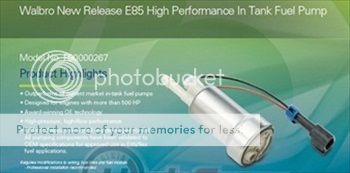
There has been reports of the low pressure fuel pump (LPFP) in the x35 motor not keeping up with ethanol concentrations higher than 60%. The LPFP struggles to hold its 72psi target pressure and tuning logs have shown primary pressure drops below 50psi. A walbro 455 LPH ethanol compatible upgraded low pressure fuel pump with faster flow is available as a direct replacement for the stock LPFP on the x35.
So far there has not been reports of issues with the high pressure fuel pump (HPFP) with the use of ethanol (despite such unsubstantiated suggestions in 2007) even though the HPFP remains a limiting factor in the overall fueling system for those aiming at serious HP numbers.
After considering the hardware requirements before pouring Ethanol 95/e5 in your tank you will have to (tune it) to accept an ethanol mix. This can be achieved through either piggyback tuning as is the case with the JB4 or with flashtuning. With the JB4 and a flexfuel sensor; using 45% ethanol has not reported any issues. If fueling errors are detected backing down on the ethanol content normally solves the fuel error issues or through fine tuning. The JB4 G5 is programmed to log low fuel pressure by default so fuelling issues can be captured and hopefully resolved.
TUNING REQUIREMENTS
A quick comment: The JB4 together with a specific BMS fueling flash tune has enabled users to take advantage of ethanol mixes and can comfortably run a 65% ethanol content (without) an upgrade to the low pressure fuel pump or the rest of the fueling system. However, concentrations above 75% ethanol demands an upgrade of the low pressure fuel pump. I personally have not tested an Ethanol 95/e5 mix with unleaded pump fuel concentration above 65% in my car. I have found that a 55% ethanol/pump fuel mix provide a perfect blend and adequate octane in conjunction with water/meth for power levels at 350Kw (@ the fly), without the need for an upgraded low pressure fuel pump. If you use the Jb4 as your preferred tune then map 3 & 5 is the ethanol autotune maps to be used without any further finetuning or modifications to the N54 vehicle. The N55 motor requires the flex fuel sensor as well.
ETHANOL 95/E5 ROAD TESTS
The best test was on the road. Myself and fellow forum member (Richard H) has been testing various ethanol concentrations for more than a year in our cars. Some tests with and without water/meth and we have been sharing our experiences and logs with each other. We now have a pretty good idea of what works and what does not.
I am not going to belabour the road test results but suffice to say: A 95/e5 mix with pump fuel (55%) makes big power on the road. You can immediately feel the difference with and without ethanol. When used in conjunction with water/meth the car felt more sharper benefitting from more cooling. Initially, both our cars struggled with cold start issues with higher ethanol concentrations during winter and fueling codes but both problems have been completely overcome with the BMS fueling flashtuning used in conjuction with the JB4 or running a lower concentration of ethanol, typically 45%.
An ethanol mix burns fast and expect a 20 Liter ethanol mix not to last very long; probably enough for a few passes at the track. Average fuel consumption was also higher. A jump from 15 L/100km to 18.5 L/100km under aggressive driving conditions. Down to an average of 16 L/100km in normal driving.
Our ethanol testing bodes well for the renewable energy cause in S.A. as an "additive" to our octane starved pump fuel. Considering the power potential of ethanol mixed with unleaded petrol and the (safer) use of ethanol compared to water/meth, I suspect more users will turn to ethanol. The hardcore enthusiast will probably continue to use water/meth in conjunction with ethanol and not replace one for the other. I am not so sure if water/meth will still be necessary as an octane "additive" when ethanol becomes more prevalent - my hunch is that without water/meth around 55% Ethanol E95/e5 and a pump fuel mix may be enough to max out the motor. The extreme low price point of ethanol (R12 - R15 per Liter) as oppose to unleaded 100 - 109 octane race fuel is another determining factor as a boosting agent of choice over the next couple of years. And as water/meth (use to be) a taboo in the BMW fraternity so will the use of Ethanol eventually find an acceptable place amongst the many fuelling alternatives out there.
CONCLUSION
In this ethanol 95/e5 performance review you have:
* Read an overview of ethanol
* Learnt a procedure to test for ethanol content
* Seen various fuel tests samples
* Read a quick comparison with other countries and
* A possible & plausible octane rating
* Been allerted to vehicle readyness requirements for ethanol use and
* Tuning aspects
* Read some road test remarks
REFERENCES
* Wikipedia on ethanol
* Protea Chemicals 95/e5 Data Sheet
* Sasol 95/e5 Data Sheet
* Ethanol Storing & Safety information
* Ethanol theory & testing & math calculations
* News article
* Sorghum for ethanol
* Walbro LPFP pump install info
NB: Using any ideas from this review is at your own risk.
:ty:
More & more fanatics are using ethanol to boost the octane in their cars. But it has been preceded with lots of frowning, vexed questions and outright uncertainty but also with a good measure of interest. There has been a number of international articles carrying mixed reactions & claims that the Ethanol (E15) in some countries can be damaging to vehicles fuel systems but that Ethanol (E85) are great for performance cars and are being used without reported issues. Whatever, the differing views the renewable energy lobbyists and agriculturists will be pleased about this unexpected development in a product that has been around for a long time. South Africa is planning the first major bio-ethanol production facility in 2013 to use sorghum to produce ethanol instead of wheat or cane. These developments bode well for an industry that has been dependent on the US for the major supply of ethanol. How this will translate in South Africa to use and promote ethanol as an alternative energy fuel source in production cars remains uncertain.
Interestingly, I heard and encountered the same uncertainty when performance enthusiasts started using water/methanol. Concerns ranging from water/meth safety; installation configurations; how does it work and how much power does it generate; what kind of mix is safe & gives the best bang for buck. But despite the concerns the use of water/meth for everyday driving is now more common place then we would think, because of our insatiable desire for better fueling options.
However, this thread is to share a review of the practical requirements, tests and use of ethanol 95/e5 in the x35 motor. As well as demystifying the use of ethanol & to finaly open this debate publicly on this forum.
ETHANOL BASICS
Ethanol (CH3CH2OH) is a clear, colorless liquid. Also known as ethyl alcohol, grain alcohol, and EtOH, the molecules in this fuel contain a hydroxyl group (-OH) bonded to a carbon atom.
Ethanol is made of the same chemical compound regardless of whether it is produced from starch- and sugar-based feedstocks, such as corn grain, sugar cane, or from cellulosic feedstocks. (Source)
ETHANOL AS A MOTOR FUEL?
Wikipedia: "The largest single use of ethanol is as a motor fuel and fuel additive. More than any other major country, Brazil relies on ethanol as a motor fuel. Gasoline sold in Brazil contains at least 25% anhydrous ethanol. Hydrous ethanol (about 95% ethanol and 5% water) can be used as fuel in more than 90% of new cars sold in the country. Brazilian ethanol is produced from sugar cane and noted for high carbon sequestration. The US uses Gasohol (max 10% ethanol) and E85 (85% ethanol) ethanol/gasoline mixtures. Ethanol may also be utilized as a rocket fuel, and is currently in lightweight rocket-powered racing aircraft."
DIFFERENCES BETWEEN e85 (US, EU & Brazil) AND 95/e5 in SOUTH AFRICA
I need to clarify this, because this has been falsely explained on US & international car forums.
It is not the same.
e85 in the US is already a pre-mixed ethanol and petrol blend which you can buy at certain fueling stations in the US & EU.
The 95/e5 composition in South Africa from Crest, Protea chemicals or SASOL and the major chemical plants is:
Ethanol 95% & Ethyl acetate 5%
Our ethanol has not been pre-mixed with petrol that you buy at a petrol station. I hope this point is clear. Of course you can buy pre-mixed ethanol/petrol from automotive workshops but it will be the (mix) of that particular workshop and they may be reluctant to reveal what the mix brew consists of.
TESTING ETHANOL IN UNLEADED PETROL & MIXED SAMPLES
Biofuel plants employ two methods for measuring ethanol concentration: Infrared ethanol sensors or a hydrometer to calculate ethanol content. Unfortunately, I dont have access to such fancy equipment and rely on a laboratory glass container best known as a test tube or graduated cylinder which can test from 0 - 85% alcohol in 1% increments. This kit may not be 100% perfect but serves as a simple guide to determine the percentage of ethanol or water content of a fuel sample.
TESTING PROCEDURES -
TEST ONE
1. Fill tube with distilled water up to the water mark. This is about 25-percent of the total volume in the tube:
2. Add the fuel sample to the neck of the bottle which is about 75-percent volume of the test tube. Replace cap and shake vigorously. Stand the tube upright with cap tight for 10 minutes and allow the solution to separate into two phases. In this test I used straight 95 pump fuel from my local Engen garage to see if any ethanol was present.
3. Locate the water/fuel seperation line and read the scale. The seperation line will indicate the percentage of ethanol if present.
In this test there was zero ethanol present in the 95 Unleaded pump fuel sample.
4. After the test dispose of the tube mix properly because it can be quite messy.
The above tube test may probably not be 100 - percent accurate for students in chemical engineering. I understand that when chemical reagents of a certain volume mix together the resulting solution does not always have a volume equal to the sum of the two reagents' volumes. So if you are an experienced lab technician or someone with a critical mathematical mind you can read up on a more detailed and accurate mathematical testing formula in one of the references at the bottom of this post.
TESTING 95/e5 ETHANOL
Now that we are familiar with the simple testing procedure lets do some ethanol testing. I grabbed some 95/e5 ethanol from Crest Chemicals.
Crest Chemicals or Protea Chemicals in Cape Town: Ethanol 95/e5
Ethanol Datasheet of the Crest Chemicals sample drum:
Composition: Ethanol 95% & Ethyl acetate 5%
Trade / Commercial Name: ETHANOL 95/E5
Chemical Name: Ethyl alcohol
Formula: C2H6O
Chemical Family: Alcohol
Synonyms: Ethanol; Anhydrol; alcohol; methylcarbinol; Denatured alcohol; ethyl hydrate; ethyl hydroxide;
TEST TWO
10 Liters 95 Unleaded Pump Fuel mixed with 10 Liters 95/e5 Ethanol -
Outcome, approximately 50% Ethanol
TEST THREE
10 Liters 95 Unleaded Pump Fuel mixed with 12 Liters 95/e5 Ethanol.
Outcome, approximately 68% ethanol.
TEST FOUR
I got hold of some BP 98 Unleaded Racefuel for interest sake and mixed a sample with distilled water. Outcome, zero ethanol present.
TEST FIVE
10 Liters, BP 98 Unleaded mixed with 12 Liters, 95/e5 Ethanol.
Outcome, approximately 65% Ethanol mix.
WHAT IS THE RON OCTANE RATING IN 95/e5?
Eish, how I looked for clarification on this question.
The short answer is: The actual octane value that you will get by adding ethanol to a fuel will vary substantially depending on what the base fuel was made of.
Most literature indicate that pure ethanol (non-denatured) will typically have a RON value of between 109 - 120 Octane. Since 95/e5 Ethanol is "denatured" a reasonable rating target would be 100.5 RON value. Popular internet answers also point out an important fact that Ethanol may actually have an even higher added "combustion enhancing" effect due to the latent heat of vaporization. So the jury is still out there until someone actually test the RON value of 95/e5 in a laboratory.
VEHICLE REQUIREMENTS BEFORE USING ETHANOL 95/E5
Unless you have purchased a full flexible sedan from Brazil to run on 100% ethanol; you cannot just pour ethanol in your car and expect it to perform. It is not going to happen and the worse case will be a damaged motor.
Modern vehicles require some modification to enable it to accept ethanol in the tank. The most common modification is a Flex Fuel Sensor. Its a device that measures and monitors the ethanol content in the car’s fuel system and is installed between the fuel pressure regulator and the fuel tank. That information is then passed onto the ECU (in the flex fuel sensor) which applies fuel, ignition and boost corrections to make the best power for the ethanol content available. There are excellent flex sensors available for various model vehicles that allows any mixture of ethanol and petrol mix (from 0-100% ethanol content).
The x35 motor also benefits from a flex fuel sensor (Above image) either sold seperately or part of a piggyback tuning solution. The flex sensor can also be substituted with specific fueling flashtuning.
There has been reports of the low pressure fuel pump (LPFP) in the x35 motor not keeping up with ethanol concentrations higher than 60%. The LPFP struggles to hold its 72psi target pressure and tuning logs have shown primary pressure drops below 50psi. A walbro 455 LPH ethanol compatible upgraded low pressure fuel pump with faster flow is available as a direct replacement for the stock LPFP on the x35.
So far there has not been reports of issues with the high pressure fuel pump (HPFP) with the use of ethanol (despite such unsubstantiated suggestions in 2007) even though the HPFP remains a limiting factor in the overall fueling system for those aiming at serious HP numbers.
After considering the hardware requirements before pouring Ethanol 95/e5 in your tank you will have to (tune it) to accept an ethanol mix. This can be achieved through either piggyback tuning as is the case with the JB4 or with flashtuning. With the JB4 and a flexfuel sensor; using 45% ethanol has not reported any issues. If fueling errors are detected backing down on the ethanol content normally solves the fuel error issues or through fine tuning. The JB4 G5 is programmed to log low fuel pressure by default so fuelling issues can be captured and hopefully resolved.
TUNING REQUIREMENTS
A quick comment: The JB4 together with a specific BMS fueling flash tune has enabled users to take advantage of ethanol mixes and can comfortably run a 65% ethanol content (without) an upgrade to the low pressure fuel pump or the rest of the fueling system. However, concentrations above 75% ethanol demands an upgrade of the low pressure fuel pump. I personally have not tested an Ethanol 95/e5 mix with unleaded pump fuel concentration above 65% in my car. I have found that a 55% ethanol/pump fuel mix provide a perfect blend and adequate octane in conjunction with water/meth for power levels at 350Kw (@ the fly), without the need for an upgraded low pressure fuel pump. If you use the Jb4 as your preferred tune then map 3 & 5 is the ethanol autotune maps to be used without any further finetuning or modifications to the N54 vehicle. The N55 motor requires the flex fuel sensor as well.
ETHANOL 95/E5 ROAD TESTS
The best test was on the road. Myself and fellow forum member (Richard H) has been testing various ethanol concentrations for more than a year in our cars. Some tests with and without water/meth and we have been sharing our experiences and logs with each other. We now have a pretty good idea of what works and what does not.
I am not going to belabour the road test results but suffice to say: A 95/e5 mix with pump fuel (55%) makes big power on the road. You can immediately feel the difference with and without ethanol. When used in conjunction with water/meth the car felt more sharper benefitting from more cooling. Initially, both our cars struggled with cold start issues with higher ethanol concentrations during winter and fueling codes but both problems have been completely overcome with the BMS fueling flashtuning used in conjuction with the JB4 or running a lower concentration of ethanol, typically 45%.
An ethanol mix burns fast and expect a 20 Liter ethanol mix not to last very long; probably enough for a few passes at the track. Average fuel consumption was also higher. A jump from 15 L/100km to 18.5 L/100km under aggressive driving conditions. Down to an average of 16 L/100km in normal driving.
Our ethanol testing bodes well for the renewable energy cause in S.A. as an "additive" to our octane starved pump fuel. Considering the power potential of ethanol mixed with unleaded petrol and the (safer) use of ethanol compared to water/meth, I suspect more users will turn to ethanol. The hardcore enthusiast will probably continue to use water/meth in conjunction with ethanol and not replace one for the other. I am not so sure if water/meth will still be necessary as an octane "additive" when ethanol becomes more prevalent - my hunch is that without water/meth around 55% Ethanol E95/e5 and a pump fuel mix may be enough to max out the motor. The extreme low price point of ethanol (R12 - R15 per Liter) as oppose to unleaded 100 - 109 octane race fuel is another determining factor as a boosting agent of choice over the next couple of years. And as water/meth (use to be) a taboo in the BMW fraternity so will the use of Ethanol eventually find an acceptable place amongst the many fuelling alternatives out there.
CONCLUSION
In this ethanol 95/e5 performance review you have:
* Read an overview of ethanol
* Learnt a procedure to test for ethanol content
* Seen various fuel tests samples
* Read a quick comparison with other countries and
* A possible & plausible octane rating
* Been allerted to vehicle readyness requirements for ethanol use and
* Tuning aspects
* Read some road test remarks
REFERENCES
* Wikipedia on ethanol
* Protea Chemicals 95/e5 Data Sheet
* Sasol 95/e5 Data Sheet
* Ethanol Storing & Safety information
* Ethanol theory & testing & math calculations
* News article
* Sorghum for ethanol
* Walbro LPFP pump install info
NB: Using any ideas from this review is at your own risk.
:ty:


 it should be stickied!


