BMW E12 V8 Racecar Build

Navigator_E90

Well-known member

Brake System Gremlin – The Most Time-Consuming Frustrating Issue​


This was not necessarily the biggest problem encountered during the build, but without question the most difficult and time-consuming gremlin to diagnose and resolve.

During the first full race at Red Star, the brake pedal began to feel progressively spongy. The issue was noticeable even in the pit area: with steady pressure, the brake pedal would slowly sink further toward the floor. On track, the problem worsened to the point of being genuinely concerning.

The only temporary solution was to pump the brake pedal repeatedly before each braking zone, which restored pedal firmness momentarily. This obviously resulted in significant time loss, but completing the race was the priority in order to gather track data.


Initial Diagnosis & Failed Assumptions​

The symptoms strongly suggested air in the brake system. However:
  • The system was bled multiple times on race day
  • No air was found during bleeding
  • No improvement was observed

Back at home, all brake lines were inspected again. A faulty master cylinder was suspected and subsequently reconditioned. This made no difference.

One notable observation during testing:
  • With the engine off, the brake pedal felt firm
  • Once the engine was started, the pedal immediately became spongy
Brake fluid type was ruled out — race-spec fluid was used throughout and tested again with no change.


Component Substitution & Isolation Testing​

The car was then taken to a race car specialist. His immediate diagnosis was again the master cylinder. To eliminate doubt, a known-good master cylinder from a running race car was fitted. The issue persisted.

A small wet area was found on a brake line, raising hopes that this was the air-entry point. The line was repaired, but once again no air was ever found during bleeding, and the pedal behavior remained unchanged.

At this stage, the braking system consisted of:
  • Stock E90 master cylinder and Booster
  • Stock E63 brake calipers and rotors
  • Braided brake lines throughout (installed from the start)
  • New new hard lines fitted during testing

ABS System Investigation​

Further research uncovered a case where similar symptoms were caused by a faulty ABS pump. With no other clear direction, the ABS unit was replaced — with no improvement.

Additional research suggested that some ABS systems require electronic bleeding via diagnostic software. The existing diagnostic tool did not support this function, so a second tool was sourced and the ABS bleeding procedure completed successfully.

Result: no change in pedal feel.


Systematic Line Isolation​

At this point, a full isolation test process was started:
  • Master cylinder outlets blanked → no pedal fade
  • Lines blanked immediately after ABS pump → no pedal fade
Rear circuit testing:
  • Right rear only → no fade
  • Left rear only → no fade
  • Both rear circuits connected → no fade
Front circuit testing:
  • Each front circuit tested individually and front combined → no fade
However:

👉 The moment all four circuits were connected simultaneously, the pedal fade returned.

This occurred despite:
  • New brake lines
  • Braided hoses
  • Multiple master cylinders
  • Brake booster replaced
  • New Vacuum lines - and vacuum pressure checked
  • New ABS units & followed bleeding process
  • Repeated bleeding cycles

Root Cause Identified​

At this point, the fault was finally identified.

I’ll explain exactly what caused this behavior and how it was resolved in the next post — as it turned out to be something extremely easy to overlook, yet almost impossible to diagnose without systematic isolation.
Would like to hear your ideas and opinions on what could have caused this, before I reveal the problem
 

Benji

Well-known member
The suspense is killing me!

Could it be some sort of short circuiting between the front/rear circuits, possibly a crack in a connection block or the separator seal thingie in the master cylinder?
 

Navigator_E90

Well-known member
Nope.
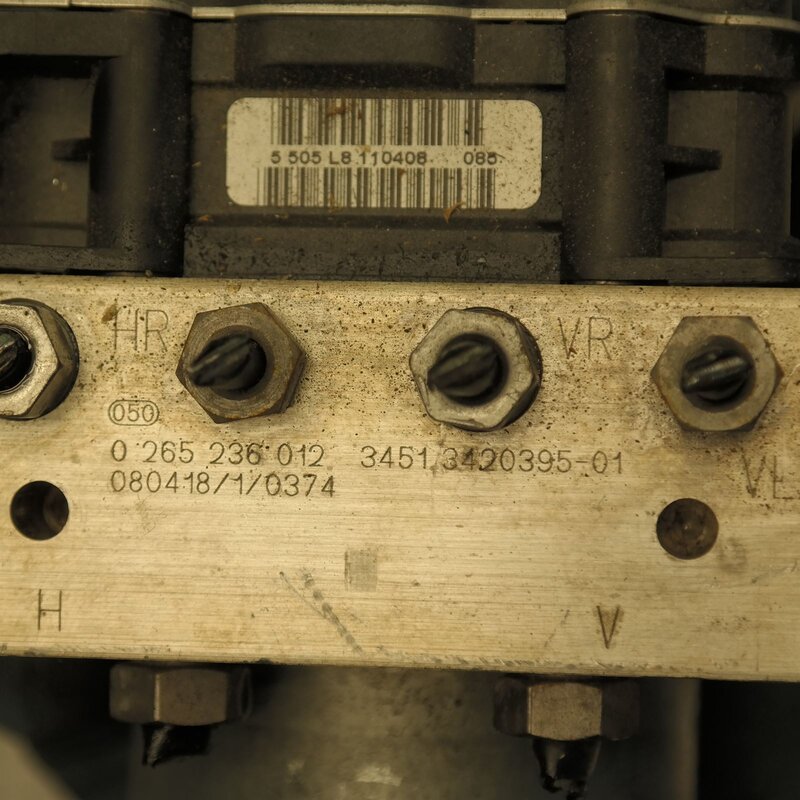
There is 2 braded hoses marked V & H from the Master Cylinder front and rear circuits directly supplying the ABS pump - then from the ABS pump hard lined to each wheel VL VR, HL HR - marked on the ABS pump for every wheel

Tip: it was a hydraulic problem
 

Attachments

  • ABS Pump.jpg
    ABS Pump.jpg
    345.7 KB · Views: 10

Navigator_E90

Well-known member

Club Racing Context & Regulations​

With the previous E90 build, I competed in the BMW M Performance Race Series, a BMW-only championship as the name suggests. The primary technical regulation is that the BMW must be powered by a BMW engine. Importantly, the engine does not need to correspond to the original model year of the chassis, which makes the E12 with the E63 V8 power plant combination fully compliant.

The championship uses a time-based classification system rather than strict technical regulations. Each class is assigned a minimum lap time per circuit. For example, at Zwartkops Raceway, a Class D car has a minimum lap time of 1:12.0 (2025 reference). If a car laps faster than the class limit — even by 0.01 seconds — it is automatically promoted to the next faster class "C".

This system allows a wide range of vehicle specifications with minimal technical restrictions, aside from mandatory safety requirements.


Race Format Changes 2026​

Previously 2025 and prior, due to the number of competitors, the series was split into two race groups:
  • Race Group 1: Classes A, B, and C
  • Race Group 2: Classes D, E, and F
Each group included both turbocharged and naturally aspirated cars in all classes

For 2026, the format was revised while still maintaining two race groups:
  • Race Group 1: Turbocharged cars only (Classes A, B, C, and D)
  • Race Group 2: Naturally aspirated cars only (Classes A, B, C, and D)

This change aims to group cars with more comparable power delivery characteristics, improving race flow and on-track safety.
Its going to be an very interesting race year!
 

Bugger

///Member
Check the link below, 1st race at RedStar Raceway
Car 57 with the wing is a turbo car - see how he pulls away in the first straight

Geez the sound of that engine is intoxicating. And it looks like so much fun.... Just great, all of the information you've provided, the insight, really is a great thread this
 

Navigator_E90

Well-known member

Brake Pedal Fade – Root Cause & Resolution​

As with many complex problems, this one halted progress for months and even caused missed race events. In hindsight the solution appears simple, but identifying it was anything but.

To recap the system configuration:
  • Chassis: E90
  • Pedal box, brake booster, and master cylinder: E90
  • Brakes: Standard E63 front and rear discs and calipers
  • Front brakes later upgraded: 6-pot calipers with larger discs
As documented previously, extensive bleeding, component replacement, and isolation testing produced no improvement.


Root Cause Identified​

The key issue turned out to be master cylinder sizing.

The E90 range spans multiple models, from the 320i up to the M3 V8 — and each model uses a different master cylinder bore size, matched to the brake system volume requirements.

The master cylinder initially fitted came from a 320i (Didnt realize that), with a 22 mm bore. This bore size was simply too small for the combined fluid volume required by:
  • Larger E63 calipers
  • Increased piston count from the 6-pot front brakes
As a result:
  • Excessive pedal travel was required to displace sufficient brake fluid
  • The master cylinder piston operated over too long a stroke
  • This manifested as a spongy, sinking brake pedal, despite no air being present in the system

Corrective Action​

The ideal solution was to fit an E90 M3 master cylinder, which uses a 27 mm bore and is correctly matched to high-volume brake systems. However, a suitable unit could not be sourced at the time.

Instead, the E63 brake booster and master cylinder were installed. This combination is designed for the larger caliper volumes used on the E63 platform and proved to be a compatible match for the current brake setup.

Result:
The spongy brake pedal was completely resolved.


New Brake Issue Identified (Unrelated)​

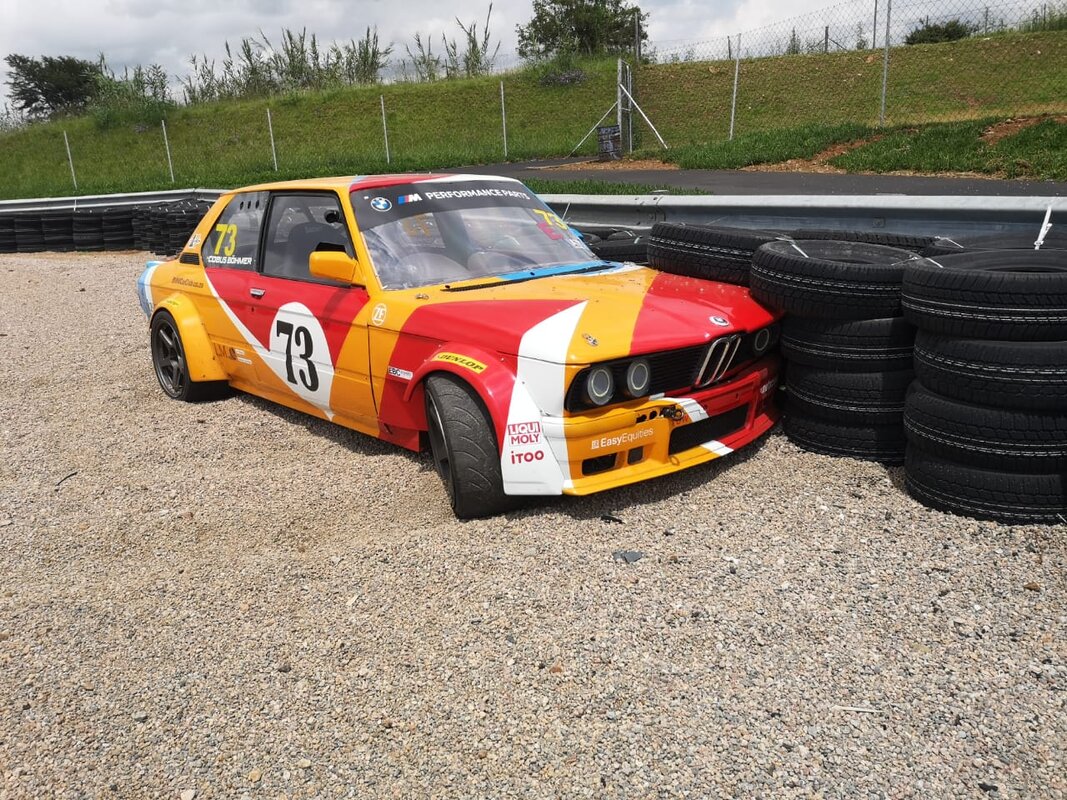
During testing on Sunday, a separate brake issue occurred. Under heavy braking at Turn 5, brake assistance was lost. Fortunately, only cosmetic damage resulted.

Key observations:
  • Brake pedal feel was excellent under normal braking
  • When pushing the braking limits, the pedal became very hard
  • Symptoms point toward insufficient vacuum supply, not hydraulic failure
This issue is not related to the original spongy pedal problem.


Next Steps​

Several options are already being evaluated to address the vacuum issue, and the plan forward is clear. Compared to the master cylinder diagnosis, this problem is expected to be far more straightforward to resolve.

Further updates will follow once testing is completed.
 

Attachments

  • E12 Turn 5.jpeg
    E12 Turn 5.jpeg
    316.2 KB · Views: 35

Benji

Well-known member
I did a slow lap in grief after seeing you in the wall. What a bummer, but I am thankful that the damage is minor...battle scars...
 

Navigator_E90

Well-known member
I did a slow lap in grief after seeing you in the wall. What a bummer, but I am thankful that the damage is minor...battle scars...
Things can escalate very quickly when something goes wrong on track, which is why thorough testing before a race weekend is critical. The risks increase exponentially once you’re surrounded by other race cars, leaving very little margin for error.


Unfortunately, there are still many competitors who skip proper testing altogether. When issues arise under race conditions, the consequences can be severe — not only for the driver involved, but for everyone else on track. They will pitch up at Friday's practice to test new modifications.... its so wrong!

Proper testing isn’t optional; it’s a fundamental part of responsible race car development.
 

ColinvS

New member
Things can escalate very quickly when something goes wrong on track, which is why thorough testing before a race weekend is critical. The risks increase exponentially once you’re surrounded by other race cars, leaving very little margin for error.


Unfortunately, there are still many competitors who skip proper testing altogether. When issues arise under race conditions, the consequences can be severe — not only for the driver involved, but for everyone else on track. They will pitch up at Friday's practice to test new modifications.... its so wrong!

Proper testing isn’t optional; it’s a fundamental part of responsible race car development.
Wow, that an awesome thread and build Cobus - you are a machine - always love seeing (and hearing) you on track.

Glad the initial brake issue with the master cylinder that caused months of missed races is sorted.

Sorry to hear that another issue reared its nasty head - do you think it is vacuum related (leak in the system or faulty one way vacuum valve or something else) or could it not be ABS related?
 

Navigator_E90

Well-known member
Wow, that an awesome thread and build Cobus - you are a machine - always love seeing (and hearing) you on track.

Glad the initial brake issue with the master cylinder that caused months of missed races is sorted.

Sorry to hear that another issue reared its nasty head - do you think it is vacuum related (leak in the system or faulty one way vacuum valve or something else) or could it not be ABS related?
Hi Colin,

Yes — it’s vacuum related. I underestimated how much vacuum is required with the bigger brakes and hard braking on a race car vs a road car.
This build has been a massive learning curve. Every time I reach the point where I think I understand the system and have it sorted, something else pops up.

In a nutshell: when you press the brake pedal, vacuum isn’t actually consumed — it only assists — so there’s no noticeable vacuum drop during hard braking. However, the moment you release the pedal, the vacuum level drops.

What I believe is happening is this: when I “test” the brakes before a corner with one or two quick pedal applications, each release causes a vacuum drop. Then, when I brake hard for the corner, there simply isn’t enough vacuum left to provide proper assistance — at least that’s the working theory.

I’ve now added a 3.8-liter vacuum reservoir to the brake system, which gives a much larger vacuum reserve. It still needs proper testing on track, but initial feel is already much better. I'm installing a vacuum gauge to truly understand how the system works, how much vacuum is used and how quickly it can recover - Ive considered installing a Volvo 12volt brake vacuum pump, but tend to be challenging in managing the pump to switch on/off during vacuum - however tested the the oem BMW pump to be stronger than the volvo pump,
Should I have not enough vacuum, which I doubt - but if - next step would be to install the volvo pump as a backup system.
 

Benji

Well-known member
Hi Colin,

Yes — it’s vacuum related. I underestimated how much vacuum is required with the bigger brakes and hard braking on a race car vs a road car.
This build has been a massive learning curve. Every time I reach the point where I think I understand the system and have it sorted, something else pops up.

In a nutshell: when you press the brake pedal, vacuum isn’t actually consumed — it only assists — so there’s no noticeable vacuum drop during hard braking. However, the moment you release the pedal, the vacuum level drops.

What I believe is happening is this: when I “test” the brakes before a corner with one or two quick pedal applications, each release causes a vacuum drop. Then, when I brake hard for the corner, there simply isn’t enough vacuum left to provide proper assistance — at least that’s the working theory.

I’ve now added a 3.8-liter vacuum reservoir to the brake system, which gives a much larger vacuum reserve. It still needs proper testing on track, but initial feel is already much better. I'm installing a vacuum gauge to truly understand how the system works, how much vacuum is used and how quickly it can recover - Ive considered installing a Volvo 12volt brake vacuum pump, but tend to be challenging in managing the pump to switch on/off during vacuum - however tested the the oem BMW pump to be stronger than the volvo pump,
Should I have not enough vacuum, which I doubt - but if - next step would be to install the volvo pump as a backup system.
Just a thought here... lets assume you lost all vacuum to the brakes, would the brakes not still work fairly effectively without vacuum assistance, especially as you would be bloody standing on them at that point? Even if they worked at half "strength" without vacuum, it should have still provided you with enough stopping power to make most of the corner.


Have a look here from 11:30, look at the skid marks, your wheels were definetely locked...Could there be a possibility that your fronts lost all braking and your rears locked up? You were also at a weird place on corner entry, but this is probably because you knew you wernt going to make the corner and were going sideways?
 

Navigator_E90

Well-known member
Just a thought here... lets assume you lost all vacuum to the brakes, would the brakes not still work fairly effectively without vacuum assistance, especially as you would be bloody standing on them at that point? Even if they worked at half "strength" without vacuum, it should have still provided you with enough stopping power to make most of the corner.


Have a look here from 11:30, look at the skid marks, your wheels were definetely locked...Could there be a possibility that your fronts lost all braking and your rears locked up? You were also at a weird place on corner entry, but this is probably because you knew you wernt going to make the corner and were going sideways?

The moment the booster/vacuum stops working the pedal becomes rock solid hard - if you can press hard enough, yip might help - but you need to press at around 150kg on the pedal,
Think the skip mark are from going sideways, Ive tried to take the corner but through the car sideways not to impact the front and hopefully expected the kitty-litter to helped more, but it didnt
However, still need to test my setup and ensure it work before I race next weekend
 

Navigator_E90

Well-known member
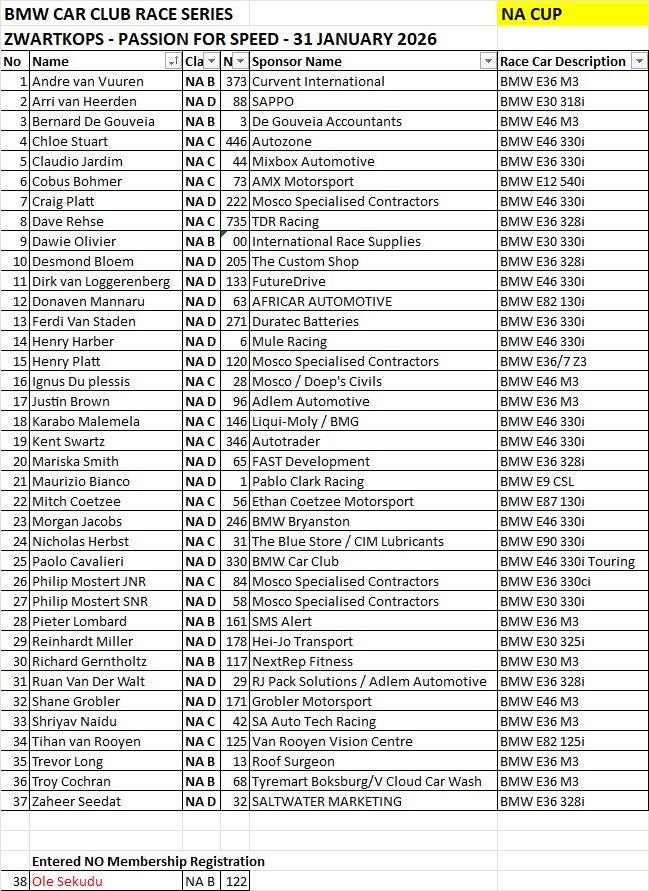
Its Race week - We have Practice on Thursday and then official practice and qualifying on Friday. 2 Races on Saturday, please see below time schedules per day.
Plan is to test the E12 Thursday, still got a few things to sort out, but all good at this time.

There is a total of 37 N/A (Non-Turbo) cars in our race, supper excited for our first race without Turbo cars!
 

Attachments

  • WhatsApp Image 2026-01-22 at 15.17.50.jpeg
    WhatsApp Image 2026-01-22 at 15.17.50.jpeg
    271 KB · Views: 8
  • SATURDAY 31JAN26.pdf
    332 KB · Views: 3
  • FRIDAY 30JAN26.pdf
    333.9 KB · Views: 1
  • THURSDAY 29JAN26.pdf
    321.1 KB · Views: 1

Navigator_E90

Well-known member
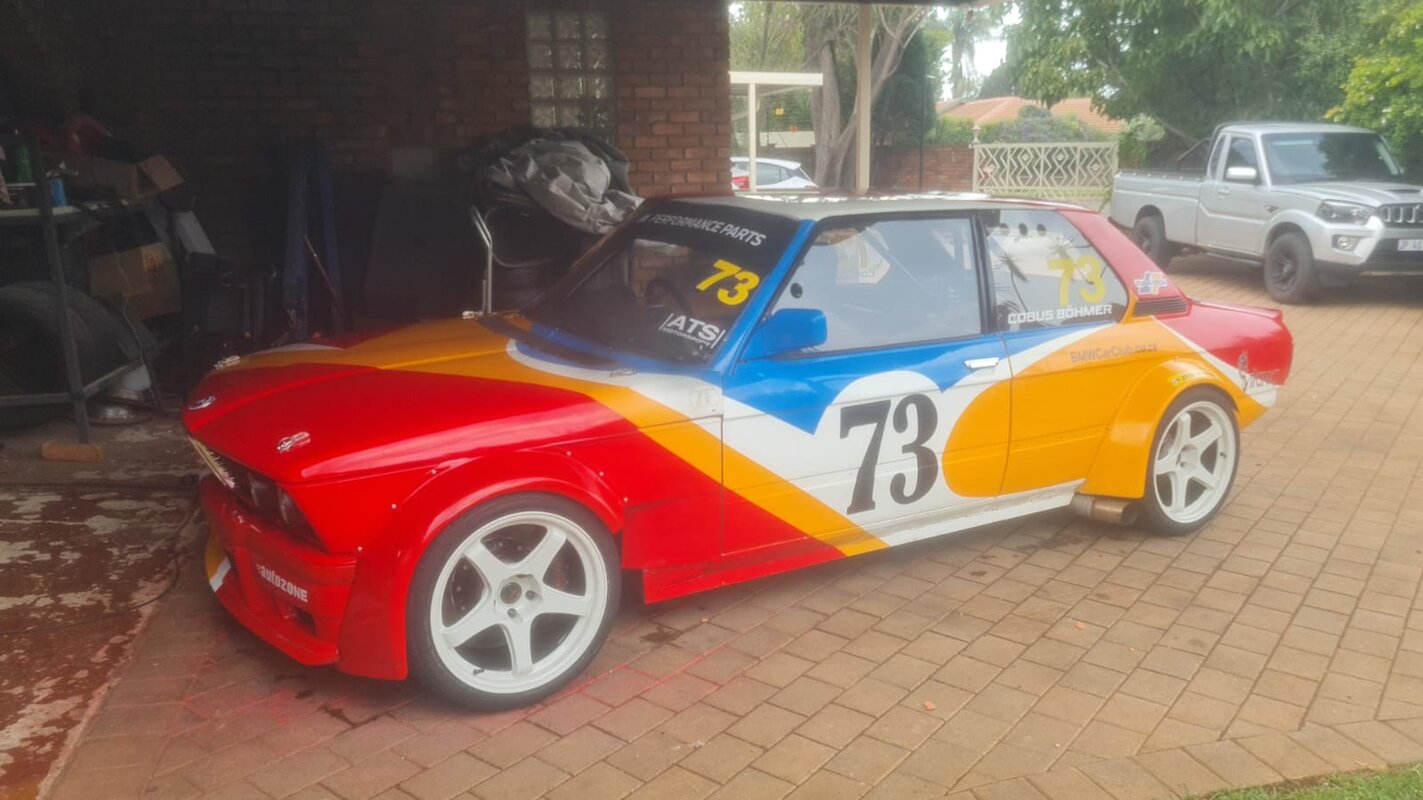
Getting ready for the weekend - while I was busy repairing the damaged bodywork, had to redo the mags as the gravel in the kitty-litter is extremely abrasive and scratched the rims badly. Wanted to change the rim color for a while - thus this was the opportunity.

Wheel alignment tomorrow morning and then 1st practice session at 13h30,
 

Attachments

  • 2026 Prep.jpeg
    2026 Prep.jpeg
    132.9 KB · Views: 23

Mytfine

Well-known member
Getting ready for the weekend - while I was busy repairing the damaged bodywork, had to redo the mags as the gravel in the kitty-litter is extremely abrasive and scratched the rims badly. Wanted to change the rim color for a while - thus this was the opportunity.

Wheel alignment tomorrow morning and then 1st practice session at 13h30,


That is now looking proper sexy.

I was thinking the bat mobile front would have suited it better but now looking at the side profile, i have changed my mind.
 
Top