Navigator_E90
Well-known member
Brake System Gremlin – The Most Time-Consuming Frustrating Issue
This was not necessarily the biggest problem encountered during the build, but without question the most difficult and time-consuming gremlin to diagnose and resolve.
During the first full race at Red Star, the brake pedal began to feel progressively spongy. The issue was noticeable even in the pit area: with steady pressure, the brake pedal would slowly sink further toward the floor. On track, the problem worsened to the point of being genuinely concerning.
The only temporary solution was to pump the brake pedal repeatedly before each braking zone, which restored pedal firmness momentarily. This obviously resulted in significant time loss, but completing the race was the priority in order to gather track data.
Initial Diagnosis & Failed Assumptions
The symptoms strongly suggested air in the brake system. However:- The system was bled multiple times on race day
- No air was found during bleeding
- No improvement was observed
Back at home, all brake lines were inspected again. A faulty master cylinder was suspected and subsequently reconditioned. This made no difference.
One notable observation during testing:
- With the engine off, the brake pedal felt firm
- Once the engine was started, the pedal immediately became spongy
Component Substitution & Isolation Testing
The car was then taken to a race car specialist. His immediate diagnosis was again the master cylinder. To eliminate doubt, a known-good master cylinder from a running race car was fitted. The issue persisted.A small wet area was found on a brake line, raising hopes that this was the air-entry point. The line was repaired, but once again no air was ever found during bleeding, and the pedal behavior remained unchanged.
At this stage, the braking system consisted of:
- Stock E90 master cylinder and Booster
- Stock E63 brake calipers and rotors
- Braided brake lines throughout (installed from the start)
- New new hard lines fitted during testing
ABS System Investigation
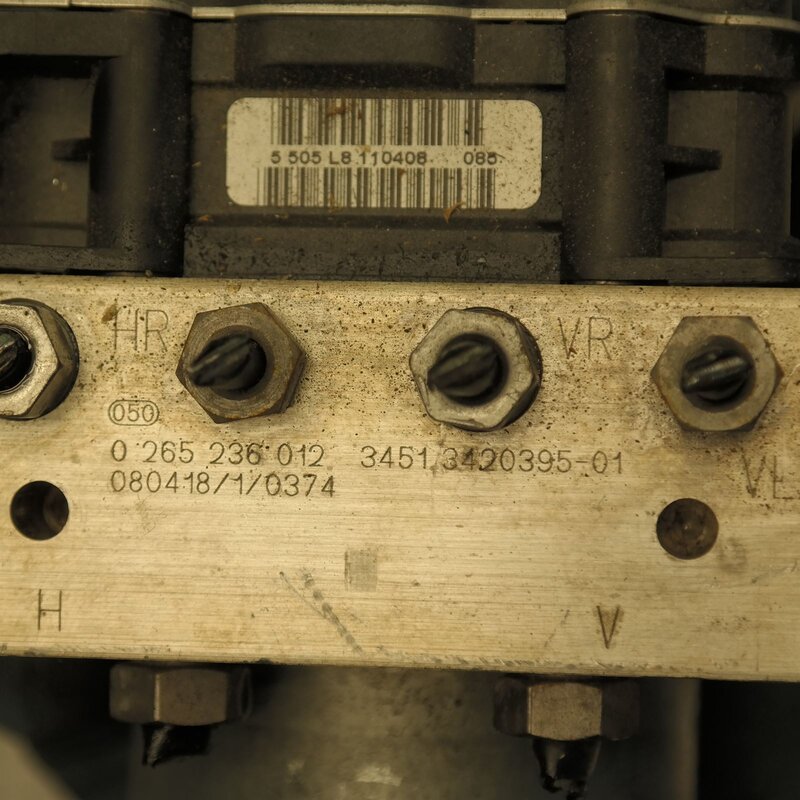
Further research uncovered a case where similar symptoms were caused by a faulty ABS pump. With no other clear direction, the ABS unit was replaced — with no improvement.Additional research suggested that some ABS systems require electronic bleeding via diagnostic software. The existing diagnostic tool did not support this function, so a second tool was sourced and the ABS bleeding procedure completed successfully.
Result: no change in pedal feel.
Systematic Line Isolation
At this point, a full isolation test process was started:- Master cylinder outlets blanked → no pedal fade
- Lines blanked immediately after ABS pump → no pedal fade
- Right rear only → no fade
- Left rear only → no fade
- Both rear circuits connected → no fade
- Each front circuit tested individually and front combined → no fade
👉 The moment all four circuits were connected simultaneously, the pedal fade returned.
This occurred despite:
- New brake lines
- Braided hoses
- Multiple master cylinders
- Brake booster replaced
- New Vacuum lines - and vacuum pressure checked
- New ABS units & followed bleeding process
- Repeated bleeding cycles
Root Cause Identified
At this point, the fault was finally identified.I’ll explain exactly what caused this behavior and how it was resolved in the next post — as it turned out to be something extremely easy to overlook, yet almost impossible to diagnose without systematic isolation.
Would like to hear your ideas and opinions on what could have caused this, before I reveal the problem