MR_Y
Well-known member
Hi,
I am a new BMW driver/owner.
Apologies if this has already been discussed at length in the past, however, I could not find a definitive answer in my online searches.
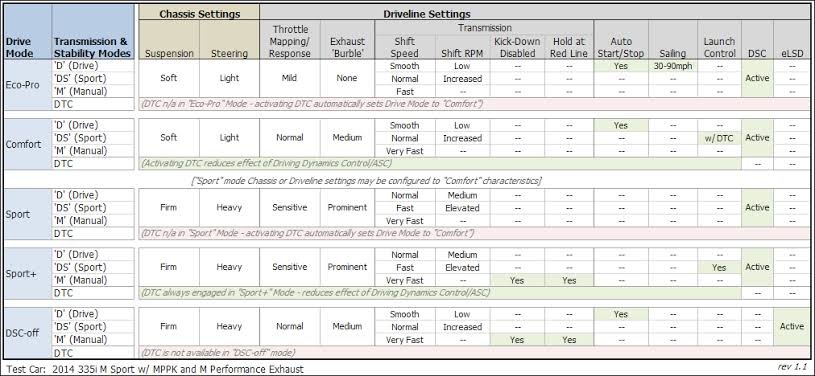
Basically, my F30 has a Sports Auto box (with D and S modes) and a Driving Experience Control Mode selector (Eco, Comfort, Sport, Sport+).
My car does not have adaptive dampers, so the Experience Modes would only affect throttle, engine and steering (?) - please correct me.
Let's consider these combinations:
1. Auto Box in D mode and Experience Mode in Sport
2. Auto Box in S mode and Experience Mode in Comfort
3. Auto Box in S mode and Experience Mode in Sport
In #1, I note that the box changes gears at higher revs, compared to the Comfort setting (also when box is in D).
In #2, it feels like the box changes at a bit more revs than #1 above. Besides the slightly higher revs, I do not feel a discernible difference between #1 and #2.
In #3, the shifts are still at high revs but they feel snappier and sportier. #3 feels clearly different from #1 and #2.
My question, what is the actual difference between #1 and #2 above? Besides, #2 having a bit more revs (honestly, feels like only a few hundred more revs per gear change compared to #1), what is actually happening behind the scenes?
In normal driving, I am in D (on gearbox) in Comfort mode. If I need to take a gap in traffic, I slot the gear into S - this is #2 above. However, this seems as effective as leaving the box in D and staying in Sport mode (Experience Mode) - #1 above.
For what it's worth, I drive a 320d, so the power is in a limited rev range, but I feel that the box and Experience Control (in any mode, besides full manual) is smart enough to keep the car automatically in the optimum rev band - the modes just specify where in that band you want to be based on your needs at that time.
I am a new BMW driver/owner.
Apologies if this has already been discussed at length in the past, however, I could not find a definitive answer in my online searches.
Basically, my F30 has a Sports Auto box (with D and S modes) and a Driving Experience Control Mode selector (Eco, Comfort, Sport, Sport+).
My car does not have adaptive dampers, so the Experience Modes would only affect throttle, engine and steering (?) - please correct me.
Let's consider these combinations:
1. Auto Box in D mode and Experience Mode in Sport
2. Auto Box in S mode and Experience Mode in Comfort
3. Auto Box in S mode and Experience Mode in Sport
In #1, I note that the box changes gears at higher revs, compared to the Comfort setting (also when box is in D).
In #2, it feels like the box changes at a bit more revs than #1 above. Besides the slightly higher revs, I do not feel a discernible difference between #1 and #2.
In #3, the shifts are still at high revs but they feel snappier and sportier. #3 feels clearly different from #1 and #2.
My question, what is the actual difference between #1 and #2 above? Besides, #2 having a bit more revs (honestly, feels like only a few hundred more revs per gear change compared to #1), what is actually happening behind the scenes?
In normal driving, I am in D (on gearbox) in Comfort mode. If I need to take a gap in traffic, I slot the gear into S - this is #2 above. However, this seems as effective as leaving the box in D and staying in Sport mode (Experience Mode) - #1 above.
For what it's worth, I drive a 320d, so the power is in a limited rev range, but I feel that the box and Experience Control (in any mode, besides full manual) is smart enough to keep the car automatically in the optimum rev band - the modes just specify where in that band you want to be based on your needs at that time.